PPA agreements in practice: how local governments, businesses and energy communities can benefit from connecting with local RES projects
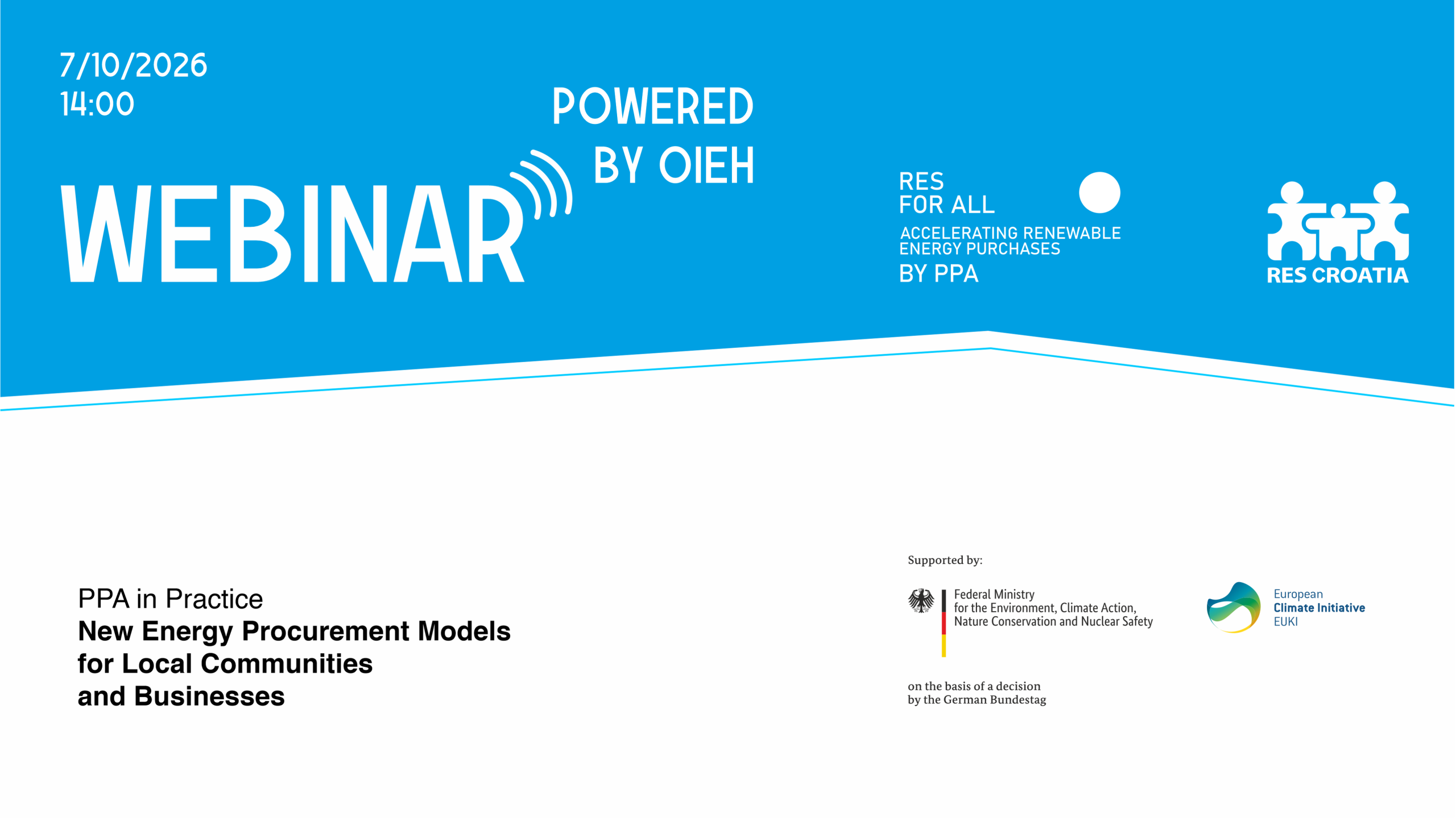
A webinar was held as part of the EUKI Renewables for All project, where examples of the application of PPA contracts in Croatia, Slovenia and France were presented.
How can businesses and local communities stabilize electricity costs in the long term and increase the share of renewable energy? Long-term power purchase agreements (PPAs) are the solution.
At the webinar “PPA in practice – new energy procurement models for local communities and entrepreneurs”, held on October 7, 2026, organized by Renewable Energy Sources of Croatia, as part of the project Renewables for All – Accelerating Renewable Energy Purchases, the existing models and the potential of PPA contracts were presented.
On-site PPA: solar power plant and battery without initial investment
Grgur Čepo, Key Account Manager at GEN-I Croatia, presented the on-site PPA contract model, which allows users to use electricity produced in a solar power plant installed at the user’s location, without the need for an initial investment in the power plant.
GEN-I is developing “smart self-supply” models, which combine a solar power plant, a battery system for energy storage and smart management of production and consumption. Under the model, GEN-I finances the construction of the power plant and the battery system, while the customer pays for the electricity at a pre-agreed price over a long-term contract period.
Battery systems have a broader role than storing energy for own consumption. Their smart management makes it possible to optimize the use of generated electricity and sell surpluses on the market. Such an approach opens up additional opportunities for increasing the economic efficiency of the system and reducing exposure to changes in electricity prices.
Energy communities: an example from Slovenia
As an example of the application of the on-site PPA model, the project of GEN-i and the Slovenian community of Ajdovščina was presented, which connects existing and new solar power plants (700 kW) and brings together approximately 230 households. The community achieves an annual production of approximately 0.9 GWh of electricity, and members among whom the energy is shared achieve average savings of approximately 9 to 10% on monthly electricity bills.
The example shows how connecting multiple users and production facilities can enable the use of renewable energy even for households that do not have the conditions to install their own solar power plant.
In Slovenia, members of energy communities are exempt from network fees, while in Croatia they are still charged. Differences in regulatory framework and costs are important for shaping business models that will enable the wider application of energy communities in Croatia.
Speaking about the possibilities of their development, Čepo pointed out that energy communities in Croatia are still in their initial phase and the development of the first such models in the Republic of Croatia is expected during 2027.
Long-term contracts for more competitive energy prices
One of the important advantages of the on-site PPA model is the possibility of negotiating the price of electricity for a longer period. According to GEN-I representatives, for households the price in this model is approximately at the level of the regulated price of electricity, while the model for industrial users can offer significantly more favorable conditions.
With financing for a period of 15 to 20 years, the price of electricity for industrial users can be around 60 EUR/MWh. Čepo pointed out that shorter-term contracts, mostly around three years, are currently available to industrial customers in Croatia, with prices that can be three to four times higher than the prices in the on-site PPA model.
Cres: virtual PPA as a business model for the energy community (case study)
Prof. Vassilis Efthymiou from the Hellenic Open University presented a business plan for an energy community on the island of Cres, developed as part of the European project ISLET, aimed at supporting energy communities on islands.
The example is based on the solar power plant project in Filozići, which is being developed by the energy cooperative Apsyrtides Coop with more than 70 members. The planned solar power plant has a capacity of 465 kW, and together with the already installed 20 kW power plant on the roof of the Girice kindergarten, the total planned installed capacity is 485 kW.
According to the presented financial model, 55% of the investment is provided by the cooperative members with their own funds, while the remaining 45% is planned to be financed with a loan.
A virtual PPA for a period of 15 years was chosen as the model for connecting producers and consumers. In the proposed model, the energy cooperative sells the generated electricity on the market and, with the energy community on Cres, financially settles the difference between the market price and the pre-agreed price of €0.094/kWh. When the market price is higher, the cooperative pays the difference to the community, and when it is lower, the community pays the difference to the cooperative.
The financial projections presented in the study predict positive EBITDA over a 25-year period, with the caveat that positive net profit is expected after year 20.
Nantes: joint public procurement of electricity from renewable sources
David Paulet, Technical Manager for Development and Project Management from SEM EnR44, presented an example of a public PPA model in Nantes, France, in which seven public entities pooled demand and jointly contracted the purchase of electricity from solar and wind power plants.
The process began in 2023, and electricity supply began on 1 January 2026. The project involves Nantes Métropole, the City of Nantes, public transport and other public entities, coordinated by Territoire d’énergie 44. Renewable electricity is provided by SEM EnR 44, as a solar energy producer, and Valorem, as a wind energy producer.
Separate contracts were concluded for solar and wind energy, a total of 14 contracts between two producers and seven customers. The contracts last for 20 years, and the pay-as-produced model implies the taking over of electricity in accordance with the actual production of the plant, the price is €87-89/MWh. PPA covers approximately 21% of the consumption of the selected facilities.
The remaining electricity supply, including balancing, is provided by a separate supplier based on a shorter contract period of two to four years.
Key benefits include cost predictability, long-term price stability and the ability to incorporate environmental and social criteria into public procurement. The association of seven public buyers has enabled the creation of sufficient demand to attract manufacturers and suppliers.
What do the examples mean for the Croatian energy sector?
The discussion showed that PPAs can be applied in different contexts – from individual companies and public institutions to energy communities and joint procurement of multiple public entities. However, successful implementation requires appropriate contractual and regulatory conditions, quality project preparation and coordination of the stakeholders involved.
A stable obligation to purchase electricity can facilitate access to financing, while the pooling of public buyers increases bargaining power and enables access to projects that may not be available to individual buyers on equal terms. Examples from Croatia, Slovenia and France show that PPA models can be an important instrument for the development of local renewable energy projects, connecting producers and consumers and involving local communities in the production and use of energy from renewable sources.
The presentation is available below, and a recording of the webinar will be posted next week on the OIEH TY page. We invite you to participate in a short survey about the knowledge of PPA contracts and their potential application in your organization.
If you are interested in more information about PPA contracts or would like to get involved in the project, please feel free to contact us. Follow all upcoming free events HERE .
The project “Renewables for All” is part of the European Climate Initiative (EUKI) of the German Federal Ministry for the Environment, Nature Protection, Nuclear Safety and Consumer Protection (BMUKN).

 17°C
17°C


Podržavaju nas